Can't personalize beyond basic email and SMS
Personalization apps you bolted on, and the ones that keep failing
Maestra Platform does it natively instead, an all-in-one retention marketing platform for ecommerce brands where a forward-deployed marketer replaces the bolted-on stack.
Brands running on Maestra






The problem
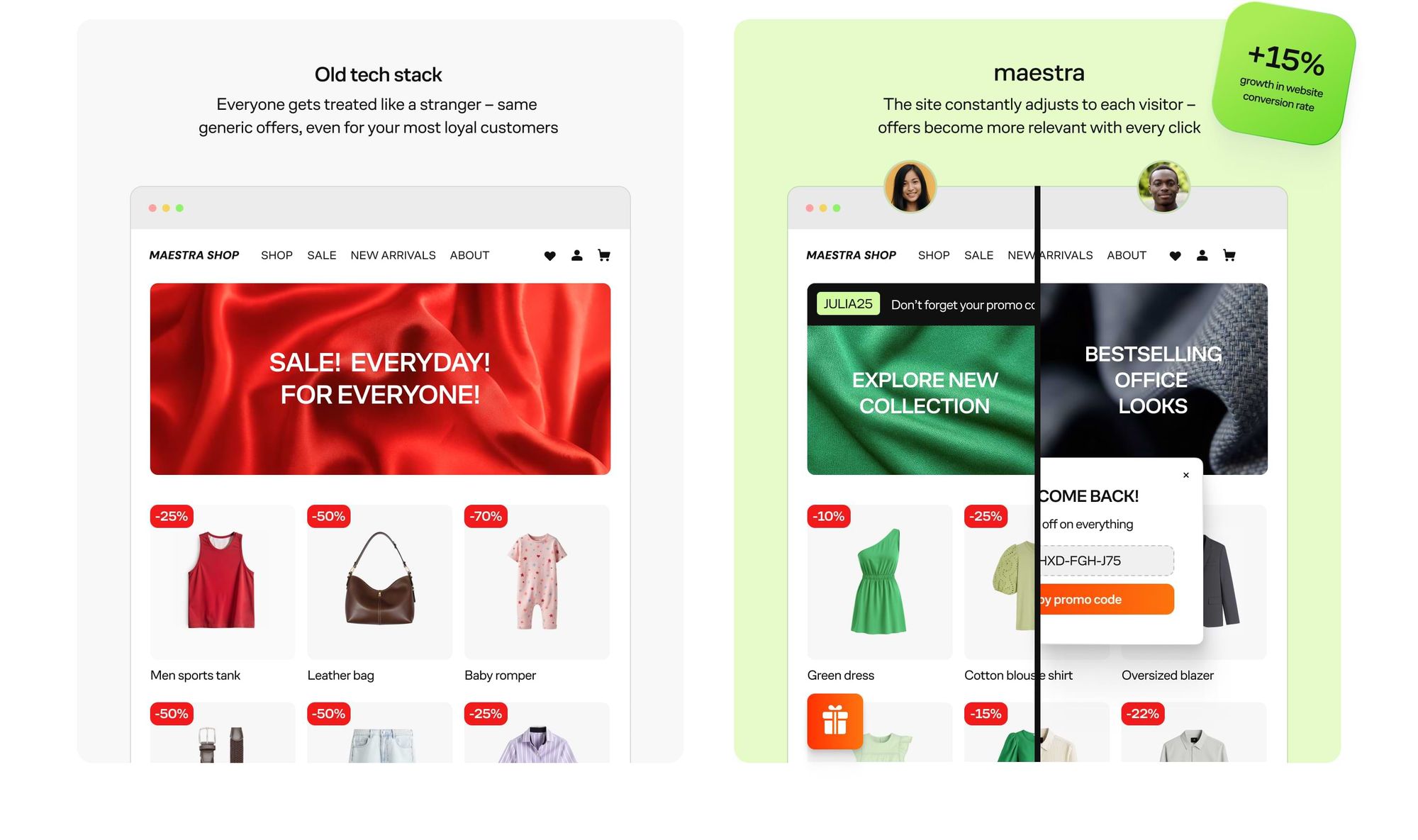
Recommendations that ignore what someone just did
Product recommendation modules often run on fixed logic: bestsellers, or a static "you might also like" block that never updates. A shopper who just looked at one category keeps seeing suggestions from a completely different one, which reads as inattention rather than personalization.
What we hear from brands
product recommendations are static and not predictive, according to a handbag brand
a kitchen-appliance brand frustrated that a shopper who just viewed a juicer gets shown a blender next
static product carousels ignore customer segments, according to a sustainable underwear brand
The new way
Turn the same catalog into a different asset for every channel
Maestra converts a product feed into on-brand dynamic visuals, with tags, ratings, and current pricing, that render in real time for ads, email, and the website alike. When a price changes, the image updates everywhere it appears, without a design request.
Customer proof
The mobile popup was converting at a quarter of a percent

Rules written for desktop were quietly wasting the majority of the traffic. A framework of A/B tests on timing and trigger took the mobile capture rate to three times what it had been.
 Read the full case study
0.26% → 0.8%
the pop-up's lead capture rate
How it works
Why this migration does not stall
One owner
A named marketer owns the move end to end instead of a ticket queue that passes it around.
Specialists on call
Deliverability and data specialists are pulled in by your marketer when a step needs them, without you making the introduction.
Momentum after launch
The improvements that are easy to postpone keep getting shipped, because someone whose job it is keeps pushing them.
The platform
Real time means the visit you are in right now
Profiles update as the shopper moves, at 2M requests per minute with responses under 300 milliseconds, so a recommendation or a banner reacts to what happened seconds ago instead of what a nightly sync knew this morning.
Including
Your forward-deployed marketer
Lessons from hundreds of brands, applied to yours
Your marketer has run this migration and these flows for ecommerce brands before, so the first version of a program starts from what already works elsewhere rather than from a blank canvas.
Patterns taken from hundreds of implementations
Ecommerce-specific expertise, not general martech
Faster results because the first draft is not guesswork
Replace your stack
The connectors go too
Every tool in a stack needs a connection to the store and to the other tools, and each of those is a thing that breaks quietly. Consolidating removes the maintenance along with the vendors.
A question worth asking your current vendor
Ask what they would build for you next month. If the answer is a help article, the comparison is already made.